Thoughts about 2014 Guatemala Mission Trip – Part 5 – Tuesday

image

In a lot of ways it is easy to describe today in one word – concrete! We spent most of the day mixing it and pouring it as we completed the floor in the kitchen at Nueva Victoria today. We still have to complete a section of sidewalk/porch for the kitchen in the morning but we did a lot of work today and we were all really dirty and tired at the end of the day.

Just so you know what mixing cement is like in a developing area, let me describe the process which I have experienced in Mexico, Peru, and now Guatemala. Concrete contains four ingredients – cement mix, sand, gravel, and water. In our world these would all be combined in a mixer and poured into the space where we want it to be. Our day started by moving twelve wheelbarrows of sand, combining it with four bags of mix into a big pile. We then moved that pile six feet away and back several times to mix the sand and cement mix. Then you create a volcano like pile and put the gravel in the middle. You then mix water with shovels and hoes. After the mix is right, and this is where we rely on our local expert, the concrete is then shoveled into five gallon buckets and then carried thirty feet to the room where it is poured onto the floor and smoothed by hand using a trowel. Imagine doing this for a 10×20 foot room and you have the idea. (Once, when I was working in the Mexican Yucatan we did the same thing on a second floor room which involved passing the buckets up a ladder!)

Needless to say, by the end of the day we had concrete from head to toe and we were very tired. However, we were also very satisfied with the job we had done!

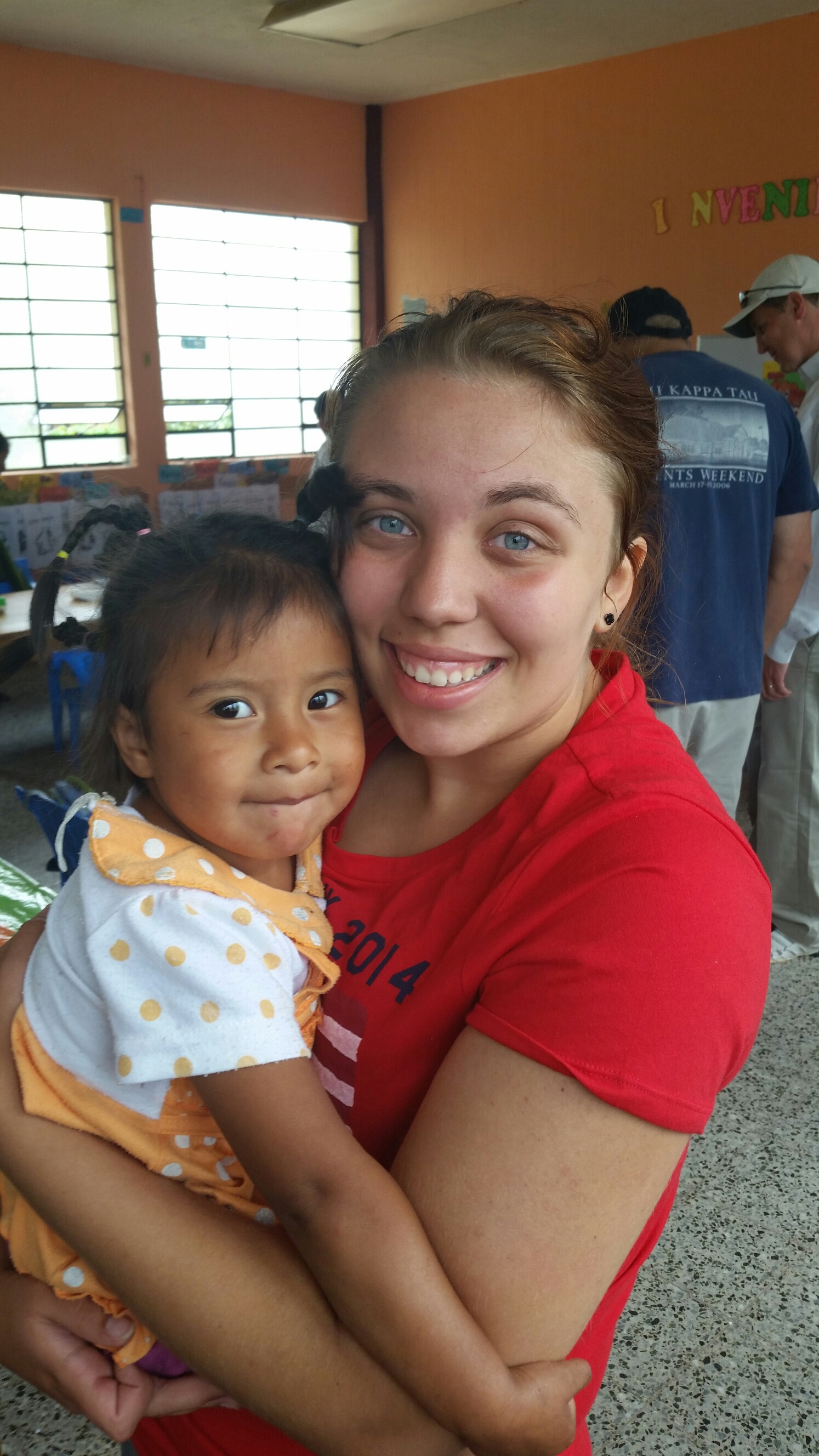
We began our day today by passing out coloring books and crayons that we had brought with us from Indiana to the students at the school where we are working on the kitchen. The children were thrilled with their gifts and several of the classes sang for us. Our translator and guide from Mission Guatemala, a young man named Diego, introduced us and played games with a couple of the classes and we all thought that watching Diego interact with the children was a real treat. We are really enjoying our time with Diego and we all think he is a blessing to us and we are grateful that Mission Guatemala has him as one of their staff members.

I want to say that I have been so inspired by the rest of the team from St. Mark’s. Today was a really long work day and from start to finish every team member was willing to chip in where needed and did it with a sense of joy and good humor. There was a lot of laughter throughout the day as well as on the van ride home which made the trip seem shorter. (I won’t mention the singing along with popular songs on the way home which had one of our local coworkers laughing and dancing in his seat!)

It was a productive and joyful day!

As a final note I want to mention that I will not be blogging tomorrow night. On Wednesday nights the work teams here at Mission Guatemala go into Panajachel, the town in which we are staying, and have dinner at a nice restaurant.
Thoughts about 2014 Guatemala Mission Trip – Part 4 – Monday

image

Today was a busy day for us. We met for prayer before breakfast and after breakfast we traveled to the medical clinic for a short tour of the clinic and the preschool there. The clinic includes a pharmacy, a dental clinic and a general medicine clinic. We met the doctor enjoyed hearing about the many ways Mission Guatemala is able to impact people’s lives through healthcare ministries.

Personally, it was fun to see several hundred boxes of food from Kids Against Hunger since our church is part of a big packing day with Kids Against Hunger every year.

As always, though, it was the children who stole our hearts. During our brief visit at the preschool adjoining the medical clinic we enjoyed interacting with the kids. I was a big hero with one little boy when I took his picture and then showed him the picture. He wanted to swipe the screen so I loaded a game and he immediately started playing the game. I was obviously not the first person to introduce him to a smart phone!

Our group from St. Mark’s traveled about 45 minutes into the mountains to work at a small village that had been displaced a few years ago by hurricane damage and had moved en masse to the mountains. To get there we had to travel by a gravel road up one mountain, down another, and back up again to a height of over 8,000 feet.

A couple of people in our group worked with a dentist who was there for the day to do tooth extractions. We were all impressed by the courage of the kids and the support of the families as the kids had their examination with the dentist. Many of them had very poor dental hygiene which is sad. As part of the examination each patient was given a toothbrush and a large tube of toothpaste.

The majority of our group worked on finishing a new kitchen for the school. The old kitchen is basically a fragile wood and tin structure with an open fire inside. The new kitchen consists of a sink with running water, a large preparation table, and two wood burning stoves in a cement block structure. Our job today was to plaster the outsides of the stoves and preparation table and to prepare the dirt floor for a new cement floor as well as preparing an area in front of the kitchen for a sidewalk/porch. We finished most of the plastering and preparation and hope that we will be able to pour the concrete floor and porch tomorrow.

The drive to and from the village was a little adventurous as it involved a lot of switch backs on gravel roads with no guard rails. We are very thankful for our driver who navigated the roads with a lot of experience and confidence.

Thoughts about 2014 Guatemala Mission Trip – Part 3 – Sunday

image

Today we spent the day learning about Guatemala which included a trip to nearby Chichicastenango, which most locals simply call “ChiChi.” This involved driving up a winding mountain road that overlooks Lake Atitlán. The photo at the top of this blog pictures the team from St. Mark’s at an overlook above the lake. There are three inactive volcanoes on the other side of the lake. It is absolutely stunning.

Once we arrived in Chichicastenango we exchanged currency, had a very nice lunch at a local restaurant, and then got to experience one of the largest outdoor marketplaces in Central America. It is sometimes overwhelming dealing with the pleas of people to buy their goods and I think it was especially difficult for some in our group who were new to the experience. We also visited a couple of Roman Catholic Churches, one of which was constructed in the sixteenth century. Several of us also toured a small museum on the local history. Overall, it was a great way to start our week in getting to know a little more about the local culture.

When we began lunch in the restaurant the final match of the World Cup between Argentina and Germany was just starting. We watched the first half of the match with a very animated Argentina fan at the next table. Throughout the afternoon wherever we went there were television screens with people watching the match – even at the little history museum. It was amazing!

After our time in the marketplace we attended a worship service at a United Methodist Church in ChiChi. Even though we could not understand everything that was sung or said, the spirit of worship was universal. The pastor was warm in his welcome of us and we were energized by the time of worship. It got particularly exciting when someone a few houses away began setting off fireworks at the beginning of the sermon. The preacher for the evening was a bilingual pastor from California and she did a great job of carrying on through the booms and pops of the fireworks.

We ended the day with a great meal back at River House when we received our work assignments for the week. Tomorrow we will be traveling to a rural village to help with a school kitchen project that is near completion. Looking forward to the new day here in Guatemala!

Thoughts about 2014 Guatemala Mission Trip – Part 1

Guatemala Mission Trip 2 In a few days I will be traveling with a group of people from my church to work at Mission Guatemala in the western highlands of Guatemala. This project was started a few years ago by my friend, Tom Heaton.  Tom has done an amazing job in a very short time in building trust and establishing the work of Mission Guatemala among the people near Lake Atitlán. Although I have heard many good things about the work of Mission Guatemala this will be my first time traveling there as well as my first short-term mission trip with people from St. Mark’s United Methodist Church, where I was appointed to serve as Lead Pastor one year ago. During the next ten days I will be sharing my experiences in Guatemala through this blog.

The next couple of days will primarily involve final preparations for the trip – making sure I finish what I need to at home and at the church, as well as finishing the always interesting job of packing. As well as figuring out what I am likely to need for the trip to physically pack, I have also discovered through the years that a venture like this involves a certain amount of emotional and spiritual packing (and unpacking) as well.

A couple of years ago I read a book by Jeffrey D. Jones called Heart, Mind, and Strength: Theory and Practices for Congregational Leadership (Herndon, VA: The Alban Institute, 2008).  In the book Jones writes:

It’s never about you.

It’s always about you.

We need to come to terms with these two seemingly conflicting realities if we are to be both effective and faithful leaders.

It’s never about you.  It’s about Christ and the church.  It’s about the way in which the system as a whole is functioning.  It’s about those you are called to serve.  It’s about the need of some people to focus their anxiety on someone or something.  It’s about the personal issues that well up and overwhelm.  It’s about the state of the world.  What happens to us as leaders stems from an array of issues and dynamics over which we have little or no control.  We get into trouble when we forget that.  We begin to take things personally or think that the reason we may be encountering resistance or not growing or finding ourselves unable to accomplish what needs to be done is that we aren’t skilled or knowledgeable or faithful enough.  But it’s never about us.

            It’s always about you.  You are Christ’s disciple.  You are part of the system and have an impact on it.  You have your own anxieties.  You have a personal life that shapes both your selfhood and your relationships.  You are touched by events in ways that influence your life and relationships.  What we accomplish as leaders depends on both our willingness and our ability to deal with whatever comes our way.  We get into trouble when we forget that.  We begin to think that we are victims or that the problem is “them.” But it’s always about us.  (Jones, 1-2)

 I have had a lot of occasions to think about these words in the past few years but especially in the past few days. Making a commitment to work on this kind of project is a reminder that it is not about me.  My role is to serve others and to be mindful of their needs.  To listen more than talk and to give myself completely to the leading of God’s spirit.

However, it is also about me in the sense that I have a responsibility to prepare myself spiritually and physically for the experience.  I have to leave behind things that might distract me and to bring along the expectation that there can be moments of divine epiphany if I am not too distracted to experience them.

And so, for the next few days I will be packing my suitcases for the journey. I will be looking over the preparation guide and packing list and hopefully I won’t forget anything that I will need along the way. And I will also be packing spiritually as I clear my mind of the things that might distract me from moments of serendipity.  Jesus once said, “For this people’s heart has become calloused; they hardly hear with their ears, and they have closed their eyes. Otherwise they might see with their eyes, hear with their ears, understand with their hearts and turn, and I would heal them.’ But blessed are your eyes because they see, and your ears because they hear.” (Matthew 13:15-16, NIV)

May it be so!

Thoughts about hope and dystopian novels

20140622-135238-49958014.jpg When I was in high school I read a lot of science fiction. I stopped reading science fiction after college and didn’t take it up again until a few years ago when I bought an e-reader and had easy access to a new crop of science fiction writers. As I have read several of the now popular science fiction books I have been struck with the change in tone in the almost thirty years between my first and most recent encounters with science fiction writing.

When I was in high school I belonged to the Science Fiction Book Club. One of the books I received was a collection of short stories titled “Dystopian Visions.” It stuck in my mind because I had to look up the word “dystopian” in order to figure out what the collection was about. A dystopian take on the future was unusual and noteworthy when the book was published in 1975. Today, however, almost every new science fiction book has a dystopian outlook. As i read such popular series as “The Hunger Games” or “Divergent” it makes me reflect on our current younger generation’s preoccupation with social catastrophe.

Recently I began reading a collection of the best science fiction short stories of 2013 edited by Jonathan Staham (The Best Science Fiction and Fantasy of the Year, volume seven). In the introduction Staham writes, “I do think science fiction – at least at the experimental/development end of the spectrum – is in a period of self-examination. Some of this is just our field’s constant navel gazing, but some is a deliberate attempt to find a way to imagine any kind of science fictional future at all. It is certainly imaginatively less innovative to revisit 1940s-style SF adventures, with those bright futures that now seem to have failed us, than to try to envision another kind of future from our own less optimistic age. And yet that is the challenge, surely. Not to imagine the way the future was, but the way the future might be. While I don’t think answers to this exist yet, I do think you can see the beginnings of attempts to find them.”

The popular novelist, Margaret Atwood, recently published an article titled “Why Readers and Writers Are Fixated With Dystopian Visions.” She begins the article by saying, “There seems to be a tidal wave of bleak futures hitting us right now.”

I am disturbed by Staham’s observation that the bright futures of my youth have failed us. Being a part of the generation that watched the first moon walk live on television and experienced the optimism that permeated that time period, I am saddened to think that my generation is perceived as having failed the generation to follow. Is there a way to rediscover the naiveté of the 1960s or is it more desirable to find a realistic future that is not utopian, but certainly more optimistic than my experience of current science fiction narratives? Have we excluded futures that provide the optimistic possibility or is this generation preoccupied with the negative factors present in our world today?

The good news is that in most of the novels I have read in this genre in the past year, there is a commitment to the indomitable spirit of humankind. Although there is often an apocalyptic event in these narratives there is also often someone who transcends social and/or technical disaster to help establish a new and better reality. What I am encouraged by is the thread of perseverance and victory in the midst of future difficulties. While most writers seem to be projecting significant social difficulties in the future of our time on this planet, there is also a nearly uniform commitment to humanities’ ultimate ability to set things right. Maybe this dystopian optimism is the best definition of hope for this generation after all. It is more pessimistic than the dreams of the 1960s but heroic in its own way.

Thoughts about some faults in “The Fault in Our Stars”

A little over a week ago I was at a conference and a friend of mine was telling me that she was amused by my reading habits on Goodreads now that I was finished with doctoral work which had dominated my reading habits for several years. I have read more novels in the past eleven months than I had in the preceding few years. In the context of the conversation she suggested I read “The Fault in Our Stars” by Indianapolis writer John Green. “Young people in your congregation are reading it,” she advised, “You should be current with what they are reading.” Then she paused, and said, “Maybe not. It’s got a lot of sadness in it.” She said that knowing that I had experienced the deaths of two of my children and thinking that this novel about two teens battling cancer and trying to figure out life might be too intense for my reality laden life.

However, having my curiosity piqued, I decided to spend most of a Saturday reading the book. Here are some of my thoughts. I will tell you that if you have not read the book and you do not want to spoil the plot you might not want to read further.

“The Fault in Our Stars” is primarily a teen romance novel although it tries to transcend that genre by dealing with some more mature life and death issues dealing with cancer and mortality. The novel is very popular with young adult readers but has garnered a significant amount of criticism for the teen characters, who many believe are more mature in their thinking than most teenagers. I really was not struck by that one way or the other, never having been a teenage girl, which is the perspective of the first person narrative, or having had terminal cancer, an important identifying factor in the ethos of the plot.

However, I have been a bereaved parent twice, and my main complaint with the novel is with the adult characters, who are often one step above the indistinguishable adult voices in a Charlie Brown special. You can attribute some of the way the adults are caricatures of real people by the fact that the novel is written from a sixteen-year-old’s perspective and that is how she experiences them. However, leaving out the two dimensional portrayal of the support group convener or the over-the-top inebriation of the God typology author (Peter Van Houten), there are a couple of items with the parents that seem too significant to really ignore.

Toward the end of the novel the two main characters, Hazel and Augustus, take a trip to Amsterdam with Hazel’s mom. Hazel has had a life threatening episode just before the trip and throughout the novel her mother is rarely out of earshot. However, even though they are thousands of miles away from the doctors with the most knowledge about her condition, Hazel’s mom suddenly abandons all concern for her daughter and heads off on her own while the young couple travel about the city mostly alone. That just seems very improbable – actually unbelievable. It is, of course, necessary to the teen romance part of the plot since the young couple needs this unsupervised time to consummate their romance. I think this is one time when the novel diverges from its mostly realistic portrayal of the end stages of cancer. No parent whose daughter had just had her lungs drained of fluid would go sightseeing alone and leave her daughter to her own devices, or the care of a seventeen-year-old boyfriend, in that circumstance.

The second major area of implausibility to me is the way the two sets of parents are portrayed. And that is that they are consistently portrayed as sets without individual voices. Having walked with many families through the last days of their children’s lives as well as the days after children’s deaths, I can say that it is extremely rare for a couple not to disagree on the treatment and care of a sick child, especially a terminally ill child. And yet, these two couples never argue with one another and consistently speak with one voice. This is not how it works in the real work. Couples wrestle with treatment decisions and rarely have complete agreement on what to do next. This is why the divorce rate among bereaved parents is so high. It is possible, but highly improbably, that two sets of parents would respond in unison like the novel portrays them.

Overall, the novel has been popular for its stark realism in portraying the teenage cancer patients and I have no reason to dispute that assessment. However, I found the adult characters two-dimensional and mostly superficial.

Thoughts about packing to move

packing boxesIn less than one week I will start a new job in a new city.  While I am excited about this new phase of my life in ministry it has created a pretty stressful Spring as I have tried to finish projects and tie up loose ends in my current work and as I begin transitioning to another ministry location.  Recently, I have thought a lot about a poem/prayer I read early in my ministry. It has stuck with me all these years and has been on my mind in the past few days as we have entered into the intense phase of packing for our upcoming move.  The poem is from a book called Psalms of My Life by Joseph Bayly (Elgin, IL: LifeJourney Books, 1987) and is called “A Psalm While Packing Books.”

A Psalm While Packing Books

This cardboard box
Lord
see it says
Bursting limit
200 lbs. per square inch.
The box maker knew
how much strain
the box would take
what weight
would crush it.
You are wiser than the box maker
Maker of my spirit
my mind
my body.
Does the box know
when pressure increases close to
the limit?
No
it knows nothing.
But I know
when my breaking point
is near.

And so I pray
Maker of my soul
Determiner of the pressure
within
upon me
Stop it
lest I be broken
or else
change the pressure rating
of this fragile container
of Your grace
so that I may bear more.

Today the representative from our moving company gave us a little lesson on how to pack boxes.  If they are too empty they tend to collapse.  If they are too full they tend to explode.  Is it possible that there is a Spiritual metaphor there?

As I think about the days in my near future I pray that they are not too empty, that I might collapse into my own self-involvement.  But I also pray that they will not be so full that the pressure of life will prove too much for the container I have become.  And finally, I pray that I might have the Spiritual wisdom to find the happy middle ground between the two.


Thoughts about tragedies and the questions they make us ask

Question MarksIn October of 1998 I ran the Chicago Marathon. I remember the feeling of exhilaration I had when I crossed the finish line. I remember the tears of joy when I hugged my wife, Michelle, and we celebrated a life accomplishment. I remember the elation of my children as they recounted how they had spent the hours while I was running at the Shedd Aquarium. What a celebration! I can’t imagine what it would be like to have that moment interrupted with a bomb.

It is less than two weeks since the bombings at The Boston Marathon and we have moved past the initial “Who?” to the more ubiquitous question: “Why?” When most of us ask that question in this context we are meaning “Why did these people do the things that they did?” We would like to know what their motives are in part so that we might be able to protect ourselves from this happening again. However, there is a bigger “Why?” Why does there exist the possibility that these things can happen? Why is it possible that a human being could conceive of a plan to kill unknown strangers in a crowd?

A few weeks ago someone asked me if I believe in the devil. In answering I quoted the membership liturgy of my church which asks us to “renounce the spiritual forces of wickedness” and “reject the evil powers of this world.” If I did not believe in the spiritual forces of wickedness and evil powers of this world before the Boston bombing I would be hard pressed to disclaim them now. Evil exists. We may disagree about the particulars of how evil manifests itself in the world but when innocent children waiting for their parent at the finish line of a racing event are murdered without cause we cannot dismiss the fact that evil exists.

I have wrestled with the big “Why?” for a long time, probably most notably when my first son died in 1986 and when my second son died in 2010. I wish I had the answer to that question. People hand me books and say, “Here, read this. It will help answer your questions.” They are sincere, well meaning people, who care about me. I suspect they want me to have my answer so that I will be in less pain and so they will feel less pain vicariously generated by my grief. And some of the answers help. But they don’t explain away the pain – they only knock feebly at the door where the answers live.

I guess I have come to terms with the mystery of the big “Why?” and have, through the years, lived with a different question: “What now?” How do I attach meaning to the questions I cannot answer and to the events in my life that I cannot explain? How do I profess faith in goodness in the midst of so much evil? How can I be optimistic in the midst of a grief that sometimes overwhelms me? These are some of the questions that we all ask at one time or another. Remarkably, I am predominantly optimistic and hopeful about life in spite of the ambiguities involved in living it.

Maybe I will write a book someday about the why questions but for now I settle for affirming the fact that I do not have to face them alone. It is the companionship of those who walk with me that provide the gentle salve that heals my soul. It is my firm conviction that God weeps with me as Jesus wept by Lazarus’ tomb that helps me feel less alone. It is the sure and certain hope that goodness will prevail in the end.

One of my favorite books, without many easy answers to difficult questions, is Praying Our Goodbyes by Joyce Rupp. Rupp reminds us that it is kinship that helps us through the difficult times. She says that “kinship is grounded in the truth expressed in 2 Corinthians 1:3-4: ‘Blessed be the God and Father of our Lord Jesus Christ, a gentle Father and the God of all consolation, who comforts us in all our sorrows, so that we can offer others, in their sorrows, the consolation that we have received from God ourselves.'” She goes on to say that “kinship is much needed for the healing of our woundedness. Our healing will be blessed by the consolation of understood pain and by a bondedness that supports us at times when we feel that the parts of our life will never reassemble into a whole again. Kinship encourages healing and with healing comes hope.” (Praying Our Goodbyes, 111)

And so, I may not have the answer you’re looking for. I’m not good at simple, easy, or aphoristic answers. What I do promise is that I will walk along with you, cry with you, laugh with you, and celebrate in the end when our questions either find ultimate answers or no longer have any relevance.

I weep for those who are most immediately affected by the tragedy in Boston. I grieve for that little piece of all of us that dies with them. But I also believe that we are co-participants in something bigger, something generative, a light that shines brighter than the darkness we now feel.

Thoughts about the Africa University Choir (and how it changed my life)

My wife, Michelle, took this photo at the Old Mutare Orphanage in 1999.

My wife, Michelle, took this photo at the Old Mutare Orphanage during our visit in 1999.

Earlier this week it was announced that the Africa University Choir will be singing in Indianapolis this summer when the United Methodists in Indiana have their annual meeting. I am excited by this announcement and a little bit frightened.  You see, the last time I heard the Africa University Choir sing it changed my life.

Fifteen years ago this summer I was attending annual conference (what United Methodist call their annual judicatory meeting) where Bishop Woodie White invited the Africa University Choir to sing.  I remember the energy of the choir and the visual beauty of their native attire. At the end of their singing Bishop White announced that he would be leading a short term work mission to Africa University the following summer and invited people to be a part of that team.  Although they would be doing hands on work with several projects on the campus, the ultimate goal would be to learn about the university, return to the Indiana area to spread this information, and to raise money to build two new dorms on the campus, a much needed addition.

I have had times in my life when I have had what I call “moments of divine clarity” – times when I feel certain of God’s presence and direction.  During and after the singing of the Africa U. Choir I felt such a moment as I have rarely, if ever, felt again.  I felt certain that God was leading me to travel with Bishop White and be a part of this project.  I went home and told Michelle the good news (?) and soon she was on board as well.  Even though it was an expensive trip and we had no visible extra means to make it happen we were sure that God would provide.  Thanks to a very loving and generous congregation a year later we were in Africa having an experience that opened our eyes to the needs of the world and also opened our eyes to what could be done when people responded to those needs with energy, creativity and financial resources.  I have often been proud of The United Methodist Church (despite all its flaws) but never more than when I stepped on the Africa U. campus for the first time.

But here’s what I didn’t count on.  I saw that trip as a kind of once-in-a-lifetime type of experience on which I could reflect with a warm feeling in the comfort of my home and church study for years to come.  I didn’t know that it would be the first step on a life-long journey to share in and share about the missional work of the church.  It was the first step on a path that has led to Mayan villages in the Yucatan, to the Peruvian high desert, to Native American communities in South Dakota, and places I haven’t even imaged yet.

In his epic set of novels, The Lord of the Rings, J.R.R. Tolkien has one of his characters muse that “Few can foresee whither their road will lead them, till they come to its end.”  I know my life journey has led me to places I never imagined and I suspect it will continue to do that if I keep open to the possibilities of it.  I have not been very good about guessing when those dangerous moments of invitation will happen nor do I know a happy way to guard myself against them.  And I doubt that I really want to.

This summer I will go to hear the Africa University Choir sing, 15 years after our first encounter that changed my life. I invite you to do the same.  I am sure that it will be a wonderful experience.  But remember this warning: If you come with an open mind and heart you may be surprised at where it leads you!

Thoughts about unison playing and teamwork

ImageAt a recent rehearsal of the Columbus City Band I found myself reminding our French horn section about the importance of achieving a good unison sound.  We were playing a piece of music (American Overture for Band by Joseph Willcox Jenkins) which features the horn section in a lot of unison playing, some of it loud and fast moving.  It is easy, in those kinds of passages,  to think that you have to play as loud as you can but the secret to being heard as a section is to achieve a good unison sound which involves listening to the other players in your section and matching tone and articulation.  Most musicians will attest to the fact that in playing and singing, achieving a good unison sound is one of the most difficult things to accomplish.

As I think about the work that I do on a daily basis I realize that this is true with most groups I work with as well.  Many times in committee and team work individual voices stick out rather than trying to listen and meld into a unified direction and mission.  When we pull in many directions we are not likely to get much done.  It is in the pulling together that we really accomplish more than we can as a group of individual workers.  It seems simple but it is often hard to convince people to give up their pet project for the good of the  overall cause just as it is hard to convince a musician to give up their individual need to be heard to become part of a unified voice.  This is why entire books have been written about the dysfunctions of teams and how a leader can help people work together.

The wisdom writer puts it this way:  “Two are better than one, because they have a good reward for their toil.   For if they fall, one will lift up the other; but woe to one who is alone and falls and does not have another to help.  Again, if two lie together, they keep warm; but how can one keep warm alone?  And though one might prevail against another, two will withstand one.  A threefold cord is not quickly broken.”  (Ecclesiastes 4:9-12)

It is a mysterious reality that working together doesn’t just multiply our efforts, they increase exponentially.  It is equally mysterious that it is so often difficult to convince people of this reality, to get them to see another viewpoint long enough to share a common vision, to work together in unison.  Lest I seem to be looking down my nose at folks who can’t achieve this let me confess that I am just as guilty of promoting my own viewpoint as the next person.  I have, however, experienced the magic of a perfect unison just often enough to give me hope and to give me pause to reflect in those moments when I need to sublimate my desires to the good of a cause or the playing of a perfect melody. Because I have learned that the interweaving of sounds and the interweaving of effort has the potential to achieve something beautiful!